Doubles Serve: Understanding the Double Chance and the First Team's Sequence
Posted Oct 21, 2026 Edited Oct 21, 2026 4 minutes to read
An article from the Jouer à Deux editorial team.
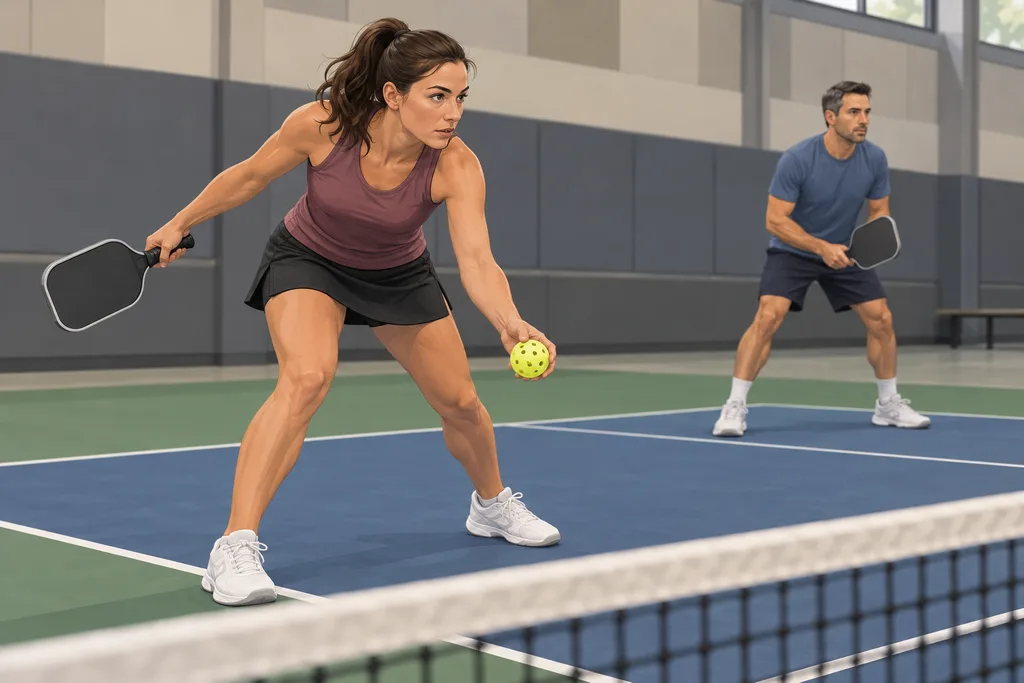
Up next: "Doubles Serve: Understanding the Double Chance and the First Team's Sequence." Settle in — it moves one step at a time. You'll know who serves, when, and how many times in a doubles game. It covers how it works in practice, how to get off to a good start, and ideas for going further. It's written for you if you fit this description: French-speaking pickleball players, beginners, club and tournament players, and people coming from tennis, padel or badminton who want to play better doubles.
How It Works in Practice
Start with this — according to the coaches the FFT interviewed, most of the communication happens off the court, in the debrief, rather than between points.
Let's set down the starting point: pickleball is most often played as doubles, even though singles exists too. Stop here for a moment and make sure it sticks.
Here's the core idea to keep in mind: a close-knit team with less talent can beat a talented but divided one, based on remarks the FFT collected.
Getting Off to a Good Start
Each number below sets up the next:
- On the doubles serve, the FFT recommends aiming for about 80% of first serves in play rather than power, and working on the body serve.
- The league championships are the first step toward the Championnats de France. They bring together the best 3.0 and 4.0 players from each region.
- The FFT stresses communication between partners — a minimal routine before each point answers two questions: which service zone the server picks, and which side the player at the net will go to.
- In a pair, you need to balance encouragement with respect for autonomy: each partner has to recognize when the other needs advice or space.
Why Does the First Team Get Only One Chance to Serve?
This count deserves your attention: the 2025 edition of the Open de France de pickleball (June 20-22, Country Club Aixois) drew more than 300 competitors and 900 matches over three days.
The official text says this: the serve is made below the hip, diagonally, and the ball must land in the opposite service zone. The server stays behind the baseline.
This count deserves your attention: competition courts built to FFT standards measure 9 m by 18 m, and the net is 6.70 m wide, 86 cm at the center and 91 cm at the posts.
What Happens When Both Partners Have Served?
This figure gives you a sense of scale — a pickleball court is 6.10 m wide by 13.41 m long, and four pickleball courts fit on one tennis court.
In the written rules, keep this in mind: pickleball was added to the FFT's statutes in January 2024.
The official text says this: games are generally played as one set to 11 or 15 points, and you must win by two points.
Ideas for Going Further
Take the time to read each of these points:
- Each player can be ranked in three categories — singles, gender doubles and mixed doubles.
- The Open d'Hiver de Marcq-en-Barœul, ranked K500, drew more than 240 unique players over its first two editions.
- In 2024, France had about 300 pickleball courts against 34,000 tennis courts, and three temporary courts were set up on the clay of Roland-Garros.
Closing Notes
Here's the substance of the text, boiled down:
- The FFT stresses communication between partners.
- Each player can be ranked in three categories.
At the End of the Read
Go back to any of these sections as needed — how it works in practice, getting off to a good start, and ideas for going further. Share this text with your regular partner and read it together.
Go further
- Playing Doubles in Pickleball: The Rules to Know Before Tactics — Rules specific to doubles: serving, rotation, scoring and the double bounce. The plan: the pillars of the approach, then the topic library.
- The Three-Number Score: Common Mistakes and How to Avoid Them — You'll learn to call the score without confusion and spot rotation errors. The reading starts with why you should begin here.
- Pickleball Doubles Rules: Serve, Double Bounce, and Non-Volley Zone — You'll know how to apply the rules specific to doubles before your first match. The article covers how it works in detail, then the action plan.
- Partner Communication: Useful Phrases and Post-Match Debriefing — You'll learn to talk with your partner effectively, during and after the match. The plan: which words to use during the rally.
Reference material
- Comment former une bonne équipe de double ? —
- Le pickleball — Federation page: ministerial delegation in early 2026, court dimensions (6.10 m x 13.41 m), mostly doubles play, federation resources and documents. Content reviewed on 2026-10-13.
- Compétitions Pickleball — Competition structure: league championships, Championnats de France, open, levels 3.0 to 5.0, rules and organization resources. Content reviewed on 2026-10-13.
- Les règles du pickleball —
- Pickleball - FFT Le Guide du club —
- La Fédération française de tennis obtient la délégation du pickleball — Announcement of January 2, 2026: duties tied to the delegation and participation figures given by the FFT (players, licenses, clubs). Content reviewed on 2026-10-13.
- Pickleball - Règles & Classement — Overview of the basic rules and the national ranking in singles, gender doubles and mixed doubles. Content reviewed on 2026-10-13.
- Pickleball well received at French Open, France expecting rapid growth — Trade press: pickleball demonstration at Roland-Garros in 2024 and the FFT's position on the sport. Content reviewed on 2026-10-13.
Rules change from one season to the next: always check the current version with the Fédération française de tennis before a competition.
Pickleball puts stress on knees, shoulders and wrists: this content doesn't replace the advice of a doctor or a physical therapist.