Partner Positioning: Where to Stand at Each Phase of the Point
Posted Oct 21, 2026 Edited Oct 21, 2026 4 minutes to read
An article by the Jouer à Deux editorial team.
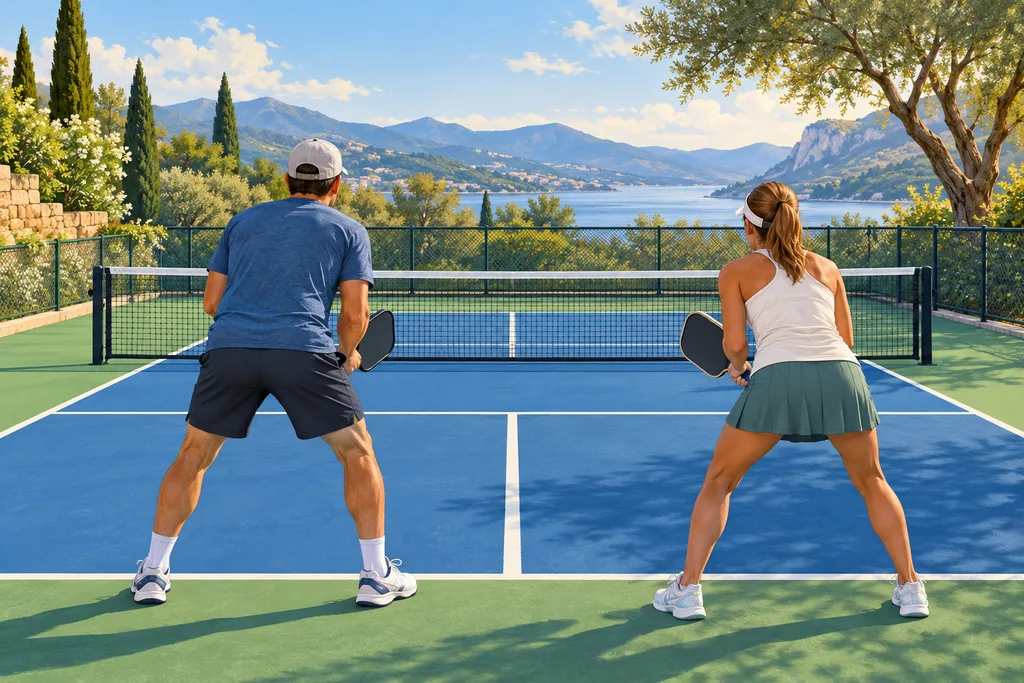
Here’s “Partner Positioning: Where to Stand at Each Phase of the Point” — read it for the nuances as much as the instructions. You’ll know how to position yourself with your partner on the serve, the return and at the net. The text follows this sequence: how it works in detail, the step-by-step method, and what to base your choice on. It’s written for you if this describes you — French-speaking pickleball players, beginners, club or tournament players, coming from tennis, padel or badminton, who want to play better doubles.
How It Works in Detail
Let’s fix this starting point — the dink is a conversation at the net, a cat-and-mouse game where the first to slip up pays for it. The FFT calls it a technical and psychological war of attrition. Use that as your compass for the rest.
On the rules side, read closely — the serve is made below the hip, diagonally, to the opposite service area, with the server standing behind the baseline.
Here’s the principle — don’t move forward until you’ve hit a shot that earns the move. A good drop earns you the right to advance. A poor drop doesn’t. Make that line your reference point from here on.
The foundation of the method is this: when choosing a doubles partner, the FFT suggests looking first for chemistry of character rather than compatibility of game. A united but less talented team can beat a divided team of stars. Stop here for a moment and make sure it sticks.
The Step-by-Step Method
Apply the following actions one after the other:
- When training a doubles team, the FFT ranks the volley among the shots to develop first — with technical communication kept to a minimum: the service area being targeted and the direction of the volleyer.
- To cover your sideline, it can help to stand closer to the line than feels comfortable — and trust your partner to handle the middle of the court.
- A debrief after the match lets you assess how well you click and how the doubles pair works together.
- A one-word call is enough to coordinate the move forward after the third shot: “Go” after a good drop so your partner advances to the non-volley line, “Back” if the shot is weak and you need to retreat.
- When you move up after the drop, watch the opponent’s ball rather than their paddle. It buys you extra decision time to choose between a reset (low ball) and an attack (high ball).
What to Base Your Choice On
Here’s the framework we suggest for deciding:
- In pickleball, the serve is simply a way to start the point, not a weapon as in tennis: it’s made below the waist, and the server can’t rush the net right away.
- To move up after the drop, you have to decide to advance before you even make contact with the ball. That avoids hesitation once the shot is hit.
- The transition zone (“no man's land”) sits between the non-volley zone and the baseline — roughly between the service line and about seven feet from the net. Cross it fast. Don’t stay in it.
- At the net, a player should treat the ball coming down their sideline as their responsibility.
- Covering your partner is anticipatory, not reactive — when they commit toward the middle, you slide right away to the side they just left, without waiting for contact with the ball.
What Trips People Up
These mistakes slip in easily — spot them:
- Three common causes explain why you end up stuck in the transition zone: a weak third shot with no suitable retreat, moving too early before you’ve seen where your ball lands, and a lack of confidence in a reliable reset.
- If you’re stuck in the transition zone, put the ball back as low and as soft as you can — ideally into the opponents’ non-volley zone — rather than hitting hard from a bad position.
By the End of the Read
The text has covered, in turn, how it works in detail, the step-by-step method, what to base your choice on, and what trips people up. Reread the passages that made you pause — that’s where your progress happens.
Go further
- Third Shot: Drop or Power Forehand? — You'll learn how to pick the right third shot for the situation. This page walks through, in order, what you need to weigh in practice.
- The Doubles Dink: Technical Basics and Tactical Goals — You'll know how to play a controlled dink and understand what it aims to achieve. The article covers how it works in detail and the first moves.
- Non-Volley Zone: Common Faults and Habits to Build — You'll know how to avoid foot faults and choose between a volley and a bounce. This page walks through, in order, why you should start here.
- Pickleball Doubles Positioning: The Complete Guide — Positioning and partner coordination on the court. You'll cover the rules of the mental game, the written resources and how to start the section.
Reference material
- Les 7 coups capitaux du pickleball —
- Les règles du pickleball —
- No Man's Land (How to avoid no man's land in pickleball: transition zone tips) — Specialized press article on the transition zone. Checked on 2026-10-13.
- Comment former une bonne équipe de double ? —
- 8 pickleball doubles strategy fixes to become a real threat —
- How to move to the kitchen line after the third shot drop — Specialized press article on moving up to the net after the third shot. Checked on 2026-10-13.
- How to cover your pickleball partner without leaving gaps — Principles of covering your partner: middle, poaching, switching sides, calls. Checked on 2026-10-15.
Rules change from one season to the next: always check the current version with the Fédération française de tennis before a competition.
Pickleball puts stress on the knees, shoulders and wrists: this content doesn't replace the advice of a doctor or a physical therapist.