Third Shot: Drop or Power Forehand?
Posted Oct 21, 2026 Edited Oct 21, 2026 4 minutes to read
An article from the Jouer à Deux editorial team.
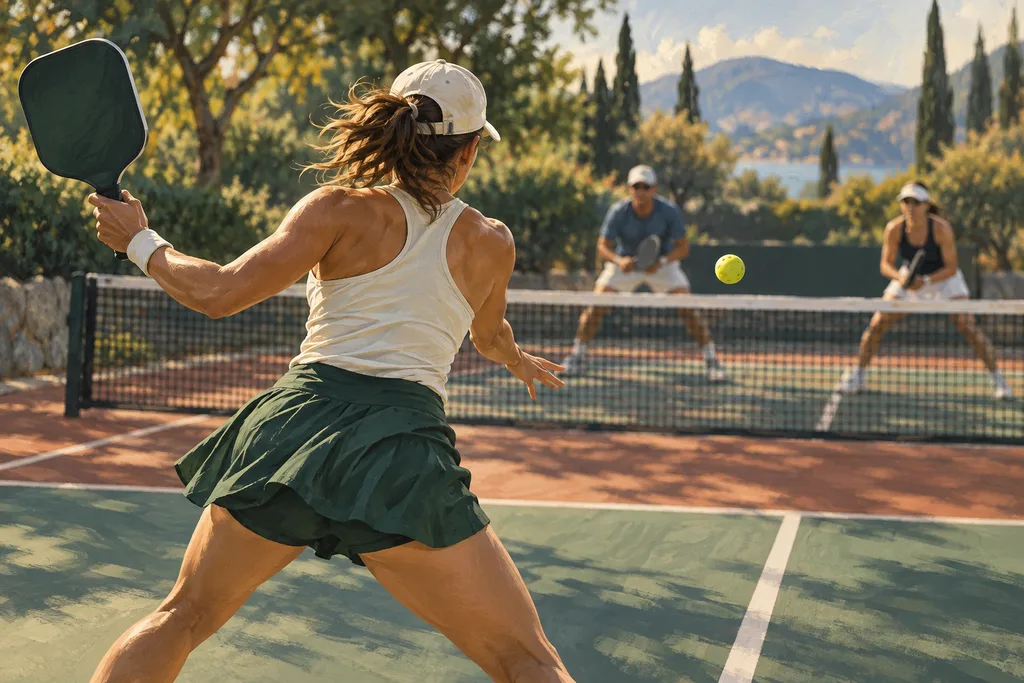
Let's go into “Third Shot: Drop or Power Forehand?” with care — note what applies to you as you read. You'll learn how to pick the right third shot for the situation. We'll cover what you need to weigh in practice, what to base your choice on, and a summary in columns. These pages are for the following readers — French-speaking pickleball players, beginners, club and tournament players, people coming from tennis, padel or badminton, who want to play better doubles.
What You Need to Weigh in Practice
Start with this principle: don't move forward until you've hit a shot that earns the move. A good drop gives you the right to move up — a poor drop doesn't.
Here's the guiding idea — in pickleball, the serve is simply a way to start the point, not a weapon as in tennis: it's made below the waist, and the server can't rush the net right away.
Here's the starting point: at the net, a player should treat a ball coming down their sideline as their responsibility. Write this principle in the margin of your notes.
What to Base Your Choice On
These points of comparison will help you decide:
- When choosing a doubles partner, the FFT suggests looking first for chemistry of character rather than playing compatibility, because a united but less talented team can beat a divided team of stars.
- When a player poaches, their partner has to make a “switch” to cover the zone left empty.
- Covering your partner is anticipatory, not reactive — when they commit toward the middle, you slide right away to the side they just left, without waiting for contact with the ball.
- Move as a unit with your partner — both players shift together toward the ball to close the gaps their own shot creates. Otherwise the opponent exploits the open court.
- To move up after the drop, the decision to advance has to be made before the ball is even hit, so you avoid hesitating once the shot is played.
The Summary in Columns
This list gathers the key points of the section:
- On the return, the returner has the upper hand — return as deep as possible and move forward as fast as possible after the shot, to push the opponent back from the net.
- Stacking means placing both players on the same side before the point, then having them move to their preferred side once the ball is in play, so each stays on the side that suits them (dominant hand, strength).
- Reading the third shot — a successful drop lands near the opponents' feet, while a ball floating at chest height is a bad drop. The partner should watch the shot to decide whether to move up.
- The transition zone (“no man's land”) sits between the non-volley zone and the baseline, roughly between the service line and about seven feet from the net. Cross it quickly — don't stay in it.
- A small split step after every move, knees slightly bent and weight balanced, keeps you ready to react fast to the next ball.
- Moving sideways in small shuffle steps rather than running forward lets you change direction instantly without losing time.
Deciding Based on Your Needs
This list gathers the key points of the section:
- On the doubles return of serve, the FFT advises starting with both players at the back, then moving toward the net as the opportunity arises.
- Time the split step to the moment your opponent hits the ball, rather than moving continuously — this improves your reaction times.
Closing Notes
Lock these points in your memory:
- Covering your partner is anticipatory, not reactive.
- Move as a unit with your partner.
Before You Go
A reminder of the thread we followed: what you need to weigh in practice, what to base your choice on, the summary in columns, and deciding based on your needs. Share this text with your regular partner and read it together.
Go further
- Pickleball Doubles Positioning: The Complete Guide — Positioning and partner coordination on the court. You'll cover the rules of the mental game, the written resources and how to start the section.
- From Tennis or Padel to Pickleball: Adapting Your Movement in Doubles — You'll know which habits from your original sport to keep and which to drop. The reading then turns to what you have to sort out in practice.
- Partner Positioning: Where to Stand at Each Phase of the Point — You'll know how to position yourself with your partner on the serve, the return and at the net. The article walks through how it works in detail.
- Non-Volley Zone: Common Faults and Habits to Build — You'll know how to avoid foot faults and choose between a volley and a bounce. This page walks through, in order, why you should start here.
Reference material
- No Man's Land (How to avoid no man's land in pickleball: transition zone tips) — Specialist press article on the transition zone. Content reviewed 2026-10-13.
- Les 7 coups capitaux du pickleball —
- 8 pickleball doubles strategy fixes to become a real threat —
- Comment former une bonne équipe de double ? —
- How to position yourself in pickleball doubles: zone map — Doubles positioning guide by zone: non-volley line, transition zone, baseline, middle. Content reviewed 2026-10-15.
- How to cover your pickleball partner without leaving gaps — Principles of covering your partner: middle, poaching, switching sides, calls. Content reviewed 2026-10-15.
- How to move to the kitchen line after the third shot drop — Specialist press article on moving up to the net after the third shot. Content reviewed 2026-10-13.
- Pickleball Stacking for beginners: full vs half stack — Specialist press article on stacking in doubles. Content reviewed 2026-10-13.
Rules change from one season to the next: always check the current version with the Fédération française de tennis before a competition.
Pickleball is hard on knees, shoulders and wrists: this content doesn't replace the advice of a doctor or physical therapist.