After the Third Shot: Linking the Fourth and Fifth
Posted Oct 21, 2026 Edited Oct 21, 2026 4 minutes to read
An article by the Jouer à Deux editorial team.
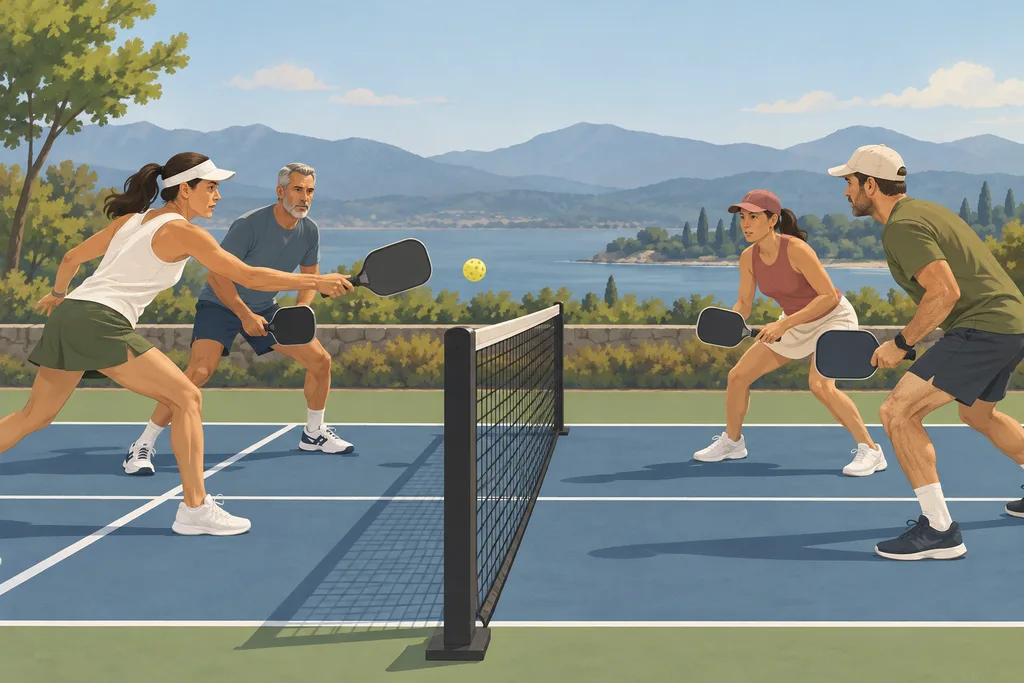
On to "After the Third Shot: Linking the Fourth and Fifth" — settle in, the discussion moves step by step. You'll learn to keep a rally going after a drop without losing the initiative. We'll work through the situation straight, the action plan, and a look at the alternatives. These pages are for the following readers — French-speaking pickleball players, beginners, club and tournament players, people coming from tennis, padel or badminton, who want to play better doubles.
The Situation, Straight
The guiding thread goes like this — in a dink rally, the first player who misses a dink or plays it sloppily gets punished right away: each side tries to keep the other from volleying until an opening appears. Come back to this idea whenever you have doubts.
Let's fix this starting point: on a pickleball volley, there's no opening of the shoulders, barely a slight turn, because the ball comes back fast and you can't afford to lose a fraction of a second — that's a difference from tennis.
The foundation of the method is this: at the net, a player should treat the ball coming down their own sideline as their responsibility. Reread that sentence slowly before moving on.
The Action Plan
Read these steps — then practice them — in order:
- Time the split step to the moment the opponent hits the ball, rather than moving continuously: it improves reaction time.
- To cover your sideline, it can help to stand closer to the line than feels comfortable, trusting your partner to handle the middle of the court.
- A debrief after the match lets you assess how well you two click and how the pair works.
- After the drop, it's advised to take two real steps toward the non-volley zone as soon as the stroke ends, then split step before reading the opponent's reply and deciding whether to advance further or stop.
- The "half stack," used only in certain situations, is presented as suited to beginners, while the "full stack" applies on every point, on serve and on return.
A Look at the Alternatives
These points of comparison will help you decide:
- The transition zone ("no man's land") sits between the non-volley zone and the baseline, roughly between the service line and about seven feet from the net; you need to cross it fast, not stay in it.
- For doubles serving, the FFT recommends aiming for about 80% of first serves in play, favoring the target zone over power.
- The drop is a very short shot that lands in the kitchen; it takes a lot of hand skill and touch to neutralize the opponent.
- Don't move up without having played a shot that earns the move: a good drop gives you the right to advance, a mediocre one doesn't.
How Do You React to the Opponent's Dink?
Build this habit into your routine — a one-word call is enough to coordinate the move forward after the third shot: "Go" after a good drop so your partner advances to the non-volley line, "Back" if the shot is weak and you need to retreat.
On the rules side, read closely — according to the FFT, after the serve the ball must bounce once on each side of the court before it can be volleyed (the double-bounce rule), which favors the returner, who can volley from their second shot on.
A recommended practice worth setting up — in a doubles team's training, the FFT lists the volley among the shots to develop first, with technical communication kept to a minimum: the target service zone and the direction of the volleyer.
When Should You Speed Up?
Picture the scene: on serve, the FFT suggests the "I" formation with the volleyer in the center, to block the angles.
Before You Go
You've gone through, in order, the situation straight, the action plan and a look at the alternatives. Share this text with your regular partner and read it together.
Go further
- Pickleball Doubles Positioning: The Complete Guide — Positioning and partner coordination on the court. You'll cover the rules of the mental game, the written resources and how to start the section.
- Non-Volley Zone: Common Faults and Habits to Build — You'll know how to avoid foot faults and choose between a volley and a bounce. This page walks through, in order, why you should start here.
- Partner Positioning: Where to Stand at Each Phase of the Point — You'll know how to position yourself with your partner on the serve, the return and at the net. The article walks through how it works in detail.
- Third Shot: Drop or Power Forehand? — You'll learn how to pick the right third shot for the situation. This page walks through, in order, what you need to weigh in practice.
Reference material
- Les 7 coups capitaux du pickleball —
- 8 pickleball doubles strategy fixes to become a real threat —
- No Man's Land (How to avoid no man's land in pickleball: transition zone tips) — Trade press article on the transition zone. Content reviewed 2026-10-13.
- Comment former une bonne équipe de double ? —
- How to move to the kitchen line after the third shot drop — Trade press article on moving up to the net after the third shot. Content reviewed 2026-10-13.
- Pickleball Stacking for beginners: full vs half stack — Trade press article on stacking in doubles. Content reviewed 2026-10-13.
- Les règles du pickleball —
Rules change from one season to the next: always check the current version with the Fédération française de tennis before a competition.
Pickleball puts stress on knees, shoulders and wrists: this content doesn't replace the advice of a doctor or a physical therapist.