Moving Up to the Net in Doubles: When and How to Do It With Your Partner
Posted Oct 21, 2026 Edited Oct 21, 2026 4 minutes to read
An article from the Jouer à Deux editorial team.
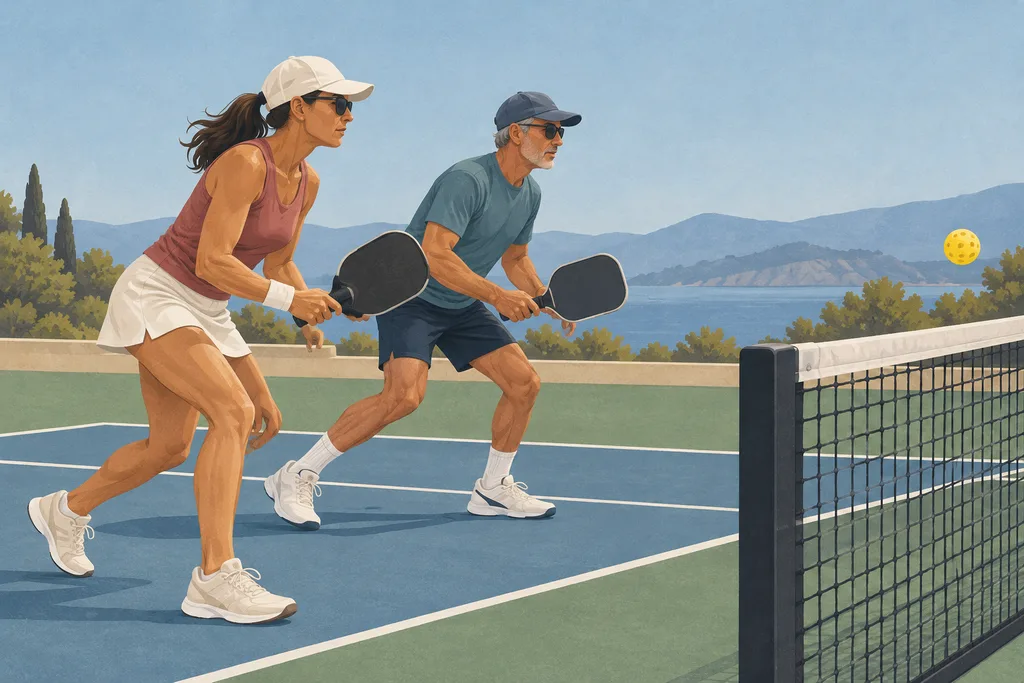
This text opens on “Moving Up to the Net in Doubles: When and How to Do It With Your Partner” — keep a pen within reach before you go on. You’ll know how to move up to the net in sync with your partner. Each block has its place in this order — the guiding idea in plain terms, the action plan and the signs of success. It was written for you if this describes you: French-speaking pickleball players, beginners, club or tournament players, coming from tennis, padel or badminton, who want to play doubles better.
The Guiding Idea in Plain Terms
The foundation of the method is this: on the return of serve, starting with both players at the back of the court keeps you from getting “shelled” at the net by the opponent and puts less pressure on the partner who returns. Treat this point as your compass for the read.
Start with this principle: stacking means placing both players on the same side before the point, then having them move to their preferred side once the ball is in play, so each stays on the side that suits them (dominant hand, strength). Jot this principle in the margin of your notes.
Start from this guiding idea — on the third shot, you choose between a drop to neutralize the opponent and a more aggressive drive, depending on the quality of the return and where the opponents are standing. Make this line your reference point from here on.
The Action Plan
Follow this sequence in the order given:
- The FFT advises working on serving at the opponent’s body and adapting your volley to the type of serve you receive.
- After a wide dink, the player positioned crosscourt should move closer to the center line with their inside foot and stay ready to take balls down the middle, otherwise they leave an exploitable gap.
- The partner of the player hitting the third shot should watch the quality of the drop (landing near the opponents’ feet, or a floating ball at chest height): that’s what determines their own next move.
- Time the split step to the moment the opponent touches the ball, rather than moving continuously: it improves reaction times.
- On the return, the returner has the upper hand — you need to return as deep as possible and move forward as fast as possible after the hit to push the opponent back from the net.
The Signs of Success
These points of comparison will help you decide:
- In a ten-minute simulation of pickleball (singles), the average heart rate measured was 130.89 beats per minute among twenty adults.
- Reading the third ball — a successful drop lands near the opponents’ feet, while a ball that floats at chest height is a bad drop; the partner should watch the shot to decide whether or not to move up.
- On the doubles serve, the FFT recommends aiming for about 80% of first balls in play, favoring the target zone over power.
Mistakes to Watch For
Spot these mistakes before they settle in:
- Three common causes explain why you end up stuck in the transition zone: a weak third shot with no suitable retreat, moving too early before you’ve seen where your ball lands, and a lack of confidence in a reliable reset.
- If your partner’s drop is weak or too high, don’t rush forward: it’s better to stay put and get ready to defend from the back than to be caught in the transition zone, vulnerable to angles.
- Stacking becomes counterproductive when the quality of the serve or the return drops, when communication between partners breaks down, or when serve placement becomes inconsistent.
- When you’re stuck in the transition zone, put the ball back as low and as soft as you can, ideally into the opponents’ non-volley zone, rather than hitting hard from a bad position.
- Don’t automatically apply the cliché “best forehand on the right”: try both sides and take into account the return, the offset and the weak points.
Before You Go
The reading path ran through the guiding idea in plain terms, the action plan, the signs of success and the mistakes to watch for — you can come back to it whenever you like. Jot your own observations in the margin — they’re worth as much as these pages.
Go further
- Nailing the Third Shot Drop: A Step-by-Step Method — You'll learn to build a reliable drop from the baseline. The article moves from the core idea in plain terms to the step-by-step method.
- From Tennis or Padel to Pickleball: Adapting Your Movement in Doubles — You'll know which habits from your original sport to keep and which to drop. The reading then turns to what you have to sort out in practice.
- The Doubles Dink: Technical Basics and Tactical Goals — You'll know how to play a controlled dink and understand what it aims to achieve. The article covers how it works in detail and the first moves.
- Pickleball Doubles Positioning: The Complete Guide — Positioning and partner coordination on the court. You'll cover the rules of the mental game, the written resources and how to start the section.
Reference material
- Comment former une bonne équipe de double ? —
- Pickleball Stacking for beginners: full vs half stack — Specialist press article on stacking in doubles. Source reviewed on 2026-10-13.
- Les 7 coups capitaux du pickleball —
- 5 pickleball court coverage mistakes in doubles — Five court-coverage mistakes in doubles and how to fix them. Source reviewed on 2026-10-15.
- 8 pickleball doubles strategy fixes to become a real threat —
- No Man's Land (How to avoid no man's land in pickleball: transition zone tips) — Specialist press article on the transition zone. Source reviewed on 2026-10-13.
- Validity and Reliability of Wearable Technology Devices during Simulated Pickleball Game Play — Validity study of smartwatches: reliable heart rate during a simulated singles game, unreliable energy expenditure estimate. Source reviewed on 2026-10-13.
- Kitchen Line Strategy: Move Together or Stagger? — Article from 07/07/2025 on moving up to the non-volley line in coordination. Source reviewed on 2026-10-15.
Rules change from one season to the next: always check the current version with the Fédération française de tennis before a competition.
Pickleball puts stress on knees, shoulders and wrists: this content doesn’t replace the advice of a doctor or a physical therapist.